
Accessible pipe repair, $200–$500
A burst you can point at, exposed pipe in a garden, garage or accessible wall, cut out and repaired in business hours.
First we stop the water. Then we find the actual split, not just where the water shows up, which is rarely the same place, and repair it properly. On call around the clock across Dural and the Hills District.
Most of what bursts around Dural is age meeting pressure. Original copper lines from the mid-century build era wear thin from the inside until a pinhole opens; older galvanised steel rusts until a fitting lets go; and garden poly lines split where a root or a shovel found them years ago. Add mains pressure that runs high across parts of the Hills District, and the weakest point eventually announces itself.
The catch is that water travels. It runs along the outside of the pipe, along joists and wall plates, and surfaces somewhere downhill of the actual split, which is why the wet patch on the ceiling is so often metres from the leak. Repairing where the water shows up fixes nothing. We trace the line back to the failure itself, repair that, and pressure-test before closing anything back up.


On sloping ground water leaves a failed pipe and travels, following the easiest path under the surface until something stops it. It can emerge metres downhill, in a neighbour's yard, or against a retaining wall.
Heavy rain off Dural’s sloping garden blocks and long driveways overwhelms pits and ag drains, choking stormwater lines until they surcharge.
So digging where the water appears is usually digging in the wrong place. Correlation and acoustic equipment work uphill from the symptom, which on a steep block routinely saves several metres of unnecessary excavation.
Dural sits in the leafy, semi-rural heart of Sydney’s Hills District (postcode 2158), an acreage suburb of large garden blocks, established nurseries and bushland strung along Old Northern Road and Round Corner. Bordering Galston, Kenthurst, Cherrybrook and Glenhaven, many homes here run on septic and tank water with long private drain lines, and we know the local ground well.
Sloping properties are full of retaining structures, and services frequently run behind or beneath them because that was the only route available. A leak in that position is both harder to reach and more consequential, saturated backfill is what makes retaining walls fail.
If water is showing at the base of a wall, treat it as urgent even if the volume looks trivial. The plumbing repair is minor next to what the wall costs.
Mains pressure varies with elevation, and properties low on a slope frequently sit at the high end of the range. Higher standing pressure shortens the life of every fitting in the house, particularly flexible hoses under sinks and behind toilets.
If you are at the bottom of a hill and you have had more than one fitting let go, a pressure test is worth doing. A pressure-limiting valve is a small part that prevents an expensive category of failure.
Most home policies cover the damage sudden escaping water does to floors, walls and contents, while treating the failed pipe itself as maintenance. So the ruined carpet is often claimable and the length of copper often is not.
Policies differ and it is worth reading yours before you need it. What helps every claim is the same: photographs before anything is moved, the time the failure was found and isolated, and a plumber's report stating what failed and why.
An accessible burst repaired in place generally runs $250-$600. Locating and repairing a concealed leak in a wall or under a floor typically sits between $600 and $1,800 depending on access, and re-piping a section of a house runs well beyond that.
Those are market figures rather than our quote. Your number is agreed before work starts, and where the fix is cheaper than you feared, that is what you will be told.
Before anything else: the stop valve at your water meter, on the boundary, usually beside the garden tap. Turn it clockwise until it stops. Every burst in the house becomes a puddle the moment you do.
Go and find it now, while nothing is wrong, and check it actually turns. A valve seized with age is common and it is far better discovered on a dry afternoon than during the event it was meant for.
The repair stops the water. It does not deal with what is already in the building, and that is where the lasting damage happens, swollen flooring, plasterboard wicking moisture upward, and mould starting within a couple of days in a warm cavity.
Lift what you can, get air moving, and if water has been under flooring or inside a wall for more than a day, say so to your insurer early. Drying is a claimable cost and it is much cheaper than the rebuild that follows not doing it.
A burst you can point at, exposed pipe in a garden, garage or accessible wall, cut out and repaired in business hours.
Adds careful access and tracing the water back to the real split before repair.
Locating equipment, access through concrete or excavation, or a reroute around the slab. The camera and leak gear keep the hole small.
Nights and weekends run roughly $180–$250/hr against $120–$160 in daylight, plus the call-out. Shutting the meter and waiting for morning is sometimes the smart money, we will say so.
Professional leak detection for the first hour, before anything is opened up. Cheaper than exploratory holes in three walls.
Every repair ends the same way: holding mains pressure on a gauge, under a lifetime workmanship warranty. Figures here are indicative of the 2026 Sydney market rather than a quote from us, you get your own number as a fixed price before any work starts.
Meter valve, clockwise, done: flood over before we leave the depot. On site we isolate just the wounded line where the plumbing allows.
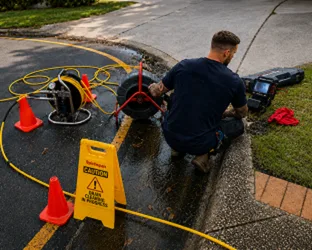
Acoustic, thermal and pressure evidence: because the failure is almost never beneath the stain, and guessing costs plaster.

The bad section comes out; new pipe goes in. If the exposed run says "replace me entirely", you get that verdict with prices for both paths.
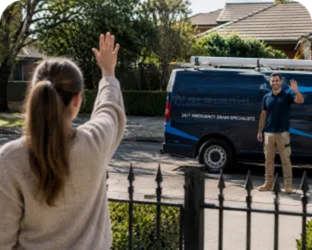
Full mains pressure against the repair while everything is still open. It passes, then the surfaces go back, in that order only.
The hard part is done, the water has stopped. Call, and we plan the repair with you before anything else gets wet.
Traced with instruments, repaired once, proven under pressure: and priced before any of it starts.

Leave your details and our local Dural team will call you back fast.